Menu

The Nautical Museum: a transformational new visitor experience

The regeneration of the Nautical Museum is a transformative development project in the heart of Castletown. It will provide a completely new, all-weather, accessible landmark visitor experience, providing a dynamic, and highly accessible and engaging visitor experience with broad appeal. This development will bring new visitors to Castletown from on and off island and will make a positive contribution to the visitor economy of the Isle of Man.

The incredible stories of our Island’s maritime past have great potential to engage our diverse audiences. The historic significance of the Nautical Museum site, and its relationship to the Peggy and George Quayle provide the perfect location to present the rich and varied nautical history of Castletown and the Isle of Man to our visitors.

The Peggy in particular is one of the most precious artefacts in the Island’s National Collections and has captured the imagination of all those who have heard her unique story.  Manx National Heritage (MNH) are committed to returning the Peggy to Castletown and exhibiting her at the heart of the regenerated Nautical Museum, telling her unique story with flair and imagination while raising the profile of our Island’s rich maritime past to an international audience.
Frequently Asked Questions (FAQs)

Last updated: September 2024

Why have Manx National Heritage developed these plans/designs for the Nautical Museum?

In 2021, as instructed by Tynwald, Manx National Heritage laid a report before Tynwald in respect of plans to return the Peggy to Castletown.  Subsequently in March 2022 Manx National Heritage updated Honourable Members with progress and committed to delivering a Business Case to Tynwald. In December 2022 MNH appointed Dannat Johnson Architects to lead the design team to develop concepts for the transformational redevelopment of the Nautical Museum.

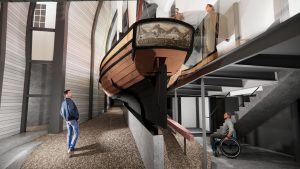
The proposals for an all-weather, accessible visitor attraction were showcased at a series of public events in August 2023 and included plans for extensive conservation works to bring the historic buildings back into a state of good repair, as well as re-purposing currently unused outbuildings. The plans included a new boat hall where the Peggy, one of the most significant items held by Manx National Heritage for the nation, will be displayed.

In 2024 the charity submitted a funding bid for the Nautical Museum transformation project to the Isle of Man Government’s Economic Strategy Board which was unsuccessful.

What will the proposed project deliver for the visitor?

The development of a vibrant world-class all-weather visitor experience will present the story of the Peggy and her owner/designer within the context of the Island’s wider maritime history. This redevelopment will create an accessible and immersive environment that will appeal to a broad audience, not just those with a maritime interest. Visitors will journey through the original buildings and encounter the spectacle of a fully-rigged Peggy beautifully and atmospherically displayed in a contemporary purpose-designed gallery.

The redevelopment of the site will enable Manx National Heritage to provide better services for school/college groups and the new boat hall and conserved historic buildings will be available as a prestigious venue to hire, year round.

Concept visuals for this transformative project can be accessed here:

Nautical Museum Concept Visualisations 2021

What is so important about the Peggy?

The Peggy is a unique survivor of international 18th century maritime history. She is the last intact surviving shallop and the oldest surviving schooner in the world. She is the oldest surviving vessel to have been fitted with sliding keels (dagger boards). Uniquely from this period, she survives nearly complete and unrestored and even more unusually, her masts and spars also survived with the vessel.

Whilst the Isle of Man is not part of the UK the significance of the Peggy is reflected in her extraordinary listing in the National Historic Fleet, a sub-set of the National Register of Historic Vessels (NRHV) managed by National Historic Ships UK.

https://www.nationalhistoricships.org.uk/register/1125/peggy

National Historic Fleet vessels are distinguished by:

  • Being of pre-eminent national or regional significance
  • Spanning the spectrum of UK maritime history
  • Illustrating changes in construction and technology
  • Meriting a higher priority for long term conservation

There are around 200 vessels in the National Historic Fleet which have been assessed for significance based on their age, design innovations, historical associations, level of originality, condition and rarity.

What is the relationship between the Nautical Museum and The Peggy?

The Nautical Museum and the Peggy are irrevocably interconnected and interdependent in terms of their heritage values and significance:

  • The Peggy was designed and built for George Quayle who was from a prominent Manx family and had a career in finance, commerce and politics.
  • The land adjacent to Bridge House, now the Nautical Museum site, was acquired by George Quayle for the express purpose of running a sailing boat and it includes Quayle’s original boathouse and private dock which were built specifically to suit the Peggy.

It is impossible to adequately tell the Peggy’s story without telling the story of George Quayle, the Nautical Museum and life in Castletown and the Isle of Man in the late 18th and early 19th centuries.

Will it still be called the Nautical Museum?

Yes. Redevelopment of the site will enable the Peggy to be placed in the wider context of our Island nation’s maritime history and more specifically against the intriguing backdrop of late 18th century Manx life, Castletown and the Quayle family. Many other MNH sites, including The House of Manannan and the Manx Museum, will continue to play an important role in telling the story of our maritime history.

What is the cost of the proposed development plan for the Nautical Museum?

£6.13m (2023).   These costs are based on the concept designs completed in 2023 and were calculated using assessments by a professional cost consultant and recent ‘actual’ exhibition design costs.

Market testing will be undertaken when full design details have been agreed and when the whole project cost is secured.

How will the project be funded?

At the time of submitting the request for funding, Manx National Heritage had secured pledges for almost a third of the overall costs of the £6.13m project and will continue to pursue sponsorship and fundraising opportunities to enable the scheme to become a reality.

If as an individual or organisation you are interested in making a financial contribution to this transformative regeneration project, please do make contact via nauticalmuseumfundraising@mnh.im for further information.

Why is the development of the Nautical Museum going to cost this amount?

The project costs are for the redevelopment of the entire site, not just for the display of the Peggy.  The costs include long overdue investment in the buildings on the site to conserve and redisplay the existing registered historic buildings and Quayle’s dock, together with the design, construction and development of a new boathouse for the Peggy and a brand new interactive exhibition throughout the site. The development will create an accessible, all-weather visitor attraction the nation can be proud of.

This will be a multifaceted project to create a world-class visitor attraction, worthy of our Manx maritime history and the Peggy. To make a positive contribution to the visitor economy we must invest in a product which meets the expectations of our well-travelled audiences.

How does the cost compare with similar projects elsewhere?

The Newport Ship, Wales, was reported in 2014 as requiring a minimum of £4m just to display the remains of the ship in a simple industrial building.  The Friends of Newport Ship (FONS) are now fundraising for a permanent display facility for the reassembled vessel. By 2023 £9m had been spent on the conservation project, but the FONS estimate that this is a minor sum compared to what is needed to display the vessel in a suitable maritime museum.  https://www.newportship.org/the-friends/our-vision

In 2016 the Mary Rose Museum in Portsmouth was completed for a sum of £39m.

Preservation and restoration of the SS Great Britain, the first iron screw propelled ocean going ship and her dry dock, including visitor facilities, was completed in 2009 at a cost of £11.3m.

Why should Government/Treasury support this when there are more pressing financial commitments?

There is a genuine appreciation that there will always be financial pressures on the public purse. Manx National Heritage has attempted to raise funding through private financial support, on and off Island, including a recently submitted application to a UK grant giving organisation, the success of which hinges on the Government also showing their support for a project of national importance.

Investment in this project will support and sustain the visitor economy of the Isle of Man and is the first significant capital investment in a heritage visitor attraction on the Island since the House of Manannan opened in 1997.

The Island is renowned for its rich heritage and Castletown has a particularly strong concentration of visitor attractions.  Heritage and Culture is one of the top reasons visitors choose to come to the Isle of Man. The addition of an accessible world-class Heritage visitor experience with one of the most significant objects in the national collections at its heart, will add to this appeal.  As an example, it was estimated that the Newport Ship could attract up to 150,000 visitors a year to Newport, boosting the south Wales economy by £7m a year.

The Isle of Man competes with many other destinations to attract visitors to the Island.  Without investment in new product development, the Isle of Man will lag behind other regions and will find it a challenge to secure repeat visits from visitors who will decide to return to other destinations which have updated and invested in the development of their visitor attractions.

How much has Manx National Heritage spent on the project to date?

£895,000 includes the cost of:

  • Removing the Peggy from the Nautical Museum to her temporary storage unit
  • Conservation and presentation of The Nautical Museum
  • Temporary storage for the Peggy including capital costs £470,000
  • Renovation materials
  • Labour for renovation of The Peggy
  • Building design and exhibition development for The Nautical Museum

The project costs to date have been funded by a combination of charitable reserves and from IOM Government.

Will this project generate jobs and further investment in Castletown?

Heritage projects are proven catalysts for regeneration. Projects in other jurisdictions have noted the economic multiplier effect in terms of increased footfall and dwell time in the town/location.

Castletown already has a concentration of Heritage attractions including one of the best preserved medieval castles in the world. The development of a world-class fully accessible visitor experience at the Nautical Museum will add to the town’s appeal as a visitor destination and increase its potential for further new investment.

It is envisaged that there will be a requirement to create new posts to fulfil the demands of the main tourist season as well as the requirement to staff the facility all year round.

How will you maximise commercial opportunities around the Nautical Museum project?

The site will have an attractive retail unit, accessible direct from the street. The design proposals have embedded opportunities for corporate bookings, year round venue hire and events, and entry ticket prices will be benchmarked against similar attractions on and off island. The needs of tour groups and the interests of cruise operators have also been considered in the design stage to ensure that the Nautical Museum delivers an appealing option for future itineraries.  Upon completion, the regenerated Nautical Museum will attract new and repeat visitors.

How accessible will the building be?

Providing access to as much of the wider Nautical Museum site as possible, for as many people as possible, has been a priority throughout the design process. This is a complex historic site, with multiple and changing floor levels and we have had to balance the need for physical access with the conservation and protection of the historic fabric of the buildings.

The new designs will provide physical access to much more of the site, the installation of a lift will take people to spaces they have never been able to visit before. There will be an accessible toilet and provision for baby-changing.

The new visitor attraction will open significant areas of the site not previously accessible to anyone.  This will maximise the footprint of the entire site, bringing more of the buildings into effective use.

How will investment in this project support or sustain the visitor economy of the Isle of Man?

The Island is renowned for its rich heritage and Castletown has a particularly strong concentration of visitor attractions at its heart.  Heritage and Culture is one of the top reasons visitors choose to come to the Isle of Man. The addition of an accessible, all-weather, world-class Heritage visitor experience displaying one of the most significant objects in the national collections at its heart, will add greatly to the Island’s appeal as a visitor destination.

How will the Nautical Museum be promoted on/off island?

We will work with the Visit Agency and Tour Operators to promote the Nautical Museum and the Isle of Man to international markets. It will feature in trade and travel shows for the tour group market and we will target specialist promotional platforms. This work will drive visits to Castletown and the Nautical Museum as a destination and to the Island as a whole.

Outreach will play a significant part in marketing and promoting the transformed Nautical Museum to Isle of Man residents.  With the capability for year-round operations, the revitalised Nautical Museum will provide opportunities for education and leisure activities and will be available for corporate and private venue hire.

Will MNH hold an open day/have a public display of plans somewhere to enable members of the public to view the proposals and provide feedback face-to face?

In Summer 2023, Manx National Heritage hosted a number of open days to showcase concept visual designs for the transformational redevelopment of the Nautical Museum in Castletown.  Displays included a digital 3D model ‘fly-thru’ of the Nautical Museum buildings providing a virtual tour of the design, which incorporates extensive conservation works to bring the historic buildings back into a state of good repair, as well as re-purposing currently unused outbuildings.

The transformative plans include a new boat hall where the Peggy, one of the most significant items held by Manx National Heritage for the nation, will be returned and displayed in a dynamic and spectacular way with film and sound used to animate her adventures on the Irish Sea.

Representatives of Manx National Heritage and the Project Design Team, Dannatt Johnson Associates, were on hand at each of the drop-in sessions to discuss the regeneration proposals and answer any questions.

It is estimated that a total at least 300 individuals attended the sessions from which 106 feedback forms were collected. Feedback from both visitors and residents to the concept visuals was overwhelmingly positive.

What feedback did you get from the public open days?

The feedback from the public sessions was almost entirely positive with all respondents stating they would be highly likely (93%) or likely (7%) to visit the completed Nautical Museum development.

Detailed feedback included:

The new Boat hall of the Nautical Museum will be a new landmark in both Castletown and on the Island. It will provide an international draw to existing heritage assets that, in our view, are under appreciated.

Our hope is that the state-of-the-art home for the newly-restored Peggy can be used to demonstrate the Island’s forward-thinking approach to visitor attractions.

The project will provide a sustainable base from which to grow footfall for the museum both generating local return visits and creating a new destination for international tourism.

The exhibition and the interpretation of the Peggy will be imaginative, engaging, immersive and playful, ensuring that visitors will return regularly with friends and family, while also acting as ambassadors for the museum, encouraging others to visit and thereby ensuring long term sustainability of the project.

Are you liaising/communicating with members of the public, political representatives and relevant local interested parties?

In 2023, a number of stakeholder engagement sessions were held to engage with the local community, local organisations and commercial operators.  Those sessions included: Castletown Commissioners, Castletown MHKs, representatives of Tynwald, and local residents.  Senior representatives of the project design team, Dannatt Johnson, were also in attendance and participated in the sessions.

Will it be open all year round and what will the opening hours/days be?

The Nautical Museum, as an all-weather visitor attraction, will have the potential for extended opening throughout the year. Opening hours will meet the needs of audiences, with options for weekend and evening openings depending on the time of year and the demand from a local and inbound market.  The site will also be available for private event bookings and educational visits.

Does it have to be world class? Why can’t we compromise and accept lower standards?

The Peggy is widely recognised as one of the most significant maritime objects in the world. The quality of her display and conservation must reflect this.  An updated and re-invigorated Nautical Museum will provide an engaging new visitor attraction with potential to provide a valuable and positive economic impact for the Island and Castletown, creating additional promotional opportunities off Island. It is important to meet the expectations of our well-travelled visitors who have wide experience of other destinations who have invested in their visitor attractions. Visitor satisfaction is essential for repeat visits and recommendations.

Why is the George Quayle story so important to the Isle of Man?

Without George Quayle there would be no Peggy and no historic boathouse. The direct associations between the historic buildings, objects, archives and George Quayle are the dominant factor in determining the history and significance of the site as a whole.

Redevelopment will enable both the story of the Quayle family and the context of the Island’s maritime history to be presented in a more coherent and engaging manner, opening more of the historic site for public access. The Nautical Museum opened in the 1950’s at a time when far less was known and understood about the intriguing and authentic story of George Quayle and the Peggy.

The wider maritime history of the Isle of Man will also continue to be told at the House of Manannan and the Manx Museum.

Why does the Peggy have to be rigged, it could be seen without the mast? The fully rigged Peggy could be presented in visuals only, rather than build a building just to have the Peggy on display with full mast?

The Peggy is important because she is the last complete surviving shallop hull and the oldest surviving schooner rigged vessel. It is in the combination of both these attributes that her significance, and her meaning, resides.  Displaying her physically, complete with her masts and sail rig will enable people to view, better appreciate and understand the boat. It will also create a spectacular visitor experience with high visual impact, attracting a wider demographic. The new boat hall itself will be a positive landmark feature in the townscape.

Why was the Peggy removed from the Nautical Museum?

To safeguard her from decay caused by high humidity and to protect her from damage caused by tidal flooding.

When will be building be completed?

The completion date is dependent on external factors, including obtaining approvals.  Funding has to be secured in full before work can commence to deliver this project.

What conservation work has been undertaken to the Peggy since she was removed from the Nautical Museum?

Since having been taken to her conservation facility in 2015 Peggy has undergone extensive survey and scientific analysis of her timbers, fixings, paint and rig. The relative humidity in the facility has been slowly reduced to 55% to bring the moisture content of the timbers to 14%. This is to prevent further rot and insect attack, and to reduce the rate of iron corrosion in her remaining fixings. Control of the ambient humidity to 55% will be an essential part of her redisplay.

Further specialised conservation work will be required to enable the Peggy to be installed in her new boat hall. The nature and detail of that work is dependent upon the final design of the Nautical Museum which will determine how the Peggy will be secured and displayed in-situ.

What other design concepts have been considered before recommending the options in the Report?

A number of design concept options for the Nautical Museum site were presented as part of the Report.  The option to display the Peggy within a new or existing building in or close to Castletown has been referred to, but no concept design has been undertaken as this is not consistent with the objective to return her to the Nautical Museum site.

Why are you not investing in other sites, which desperately need updating and maintenance?

The Nautical Museum has been part of the MNH portfolio since the 1950s and has had very little investment over the past 70 years.  There have been no major upgrades to either the displays, the visitor facilities or the conservation of the historic buildings. The proposal to transform the Nautical Museum will address this historic lack of investment and will address the conservation deficit of the whole site.

We absolutely recognise that all Manx National Heritage sites require a continual cycle of investment and improvement in order to meet contemporary visitor expectations.

It is also critically important to secure ongoing and adequate funding resource to invest in essential ongoing maintenance required at each site. The conservation and preservation of the nation’s heritage is vital for the protection of our built, natural and cultural heritage for future generations to enjoy.

Project Documents

Your support of our charity can make a real difference to projects like this and the wider preservation and enjoyment of the Isle of Man’s natural and cultural heritage.  Our incredible sites, collections and special projects motivate many to support our work. We hope you will join them.

DONATE ONLINE NOW

Back to top