
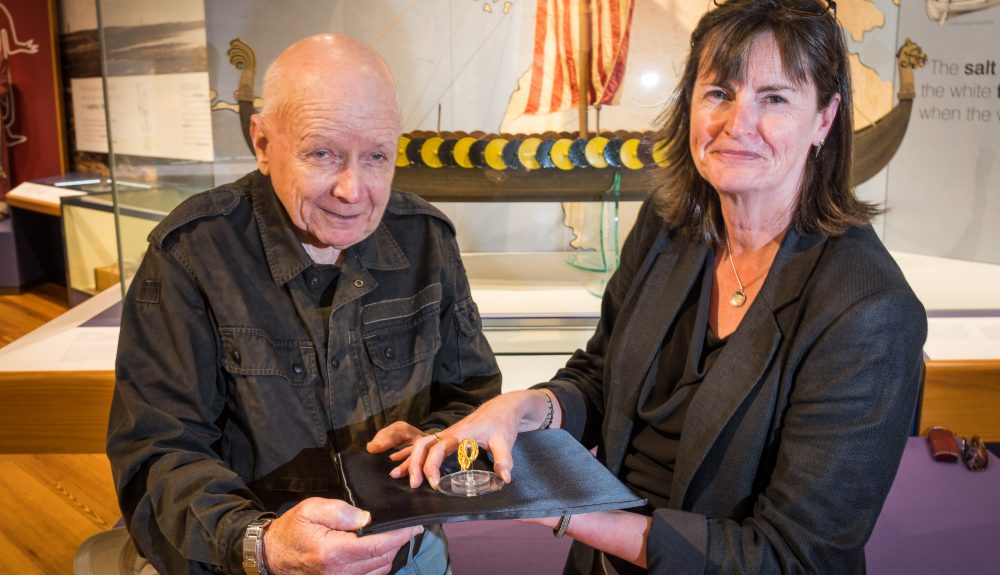
The understanding of the Isle of Man’s rich Viking legacy has been further enhanced by the discovery of the Island’s latest treasure hoard, which was today declared Treasure by the Isle of Man Deputy Coroner of Inquests.
The latest hoard consists of a rare fragment of gold arm-ring which belonged to a Viking, who lived on the Isle of Man around one thousand years ago. Discovered by metal detectorist Ronald Clucas in spring 2025, the find dates to around AD 1000-1100.
Created by plaiting eight strands of gold rods together, the arm-ring was made by a highly skilled goldsmith using a specialised technique. The piece was found folded in two and is around 3.7cm in length, although would have originally been around 7.7cm in length. The fragment weighs 27.26g, a significant weight for a fragment of jewellery of it’s size.
Finder Ronald Clucas, a member of the Manx Detectorist Society, said:
“It was quite a big shock to discover this lovely piece of gold, I couldn’t really believe it at first! Gold generally gives a very low signal on the detector, so you can’t really predict what is going to be uncovered. I’ve been detecting for many years now and found some wonderful things, but to find a piece of gold from the Viking Age, that’s really something else.”
Allison Fox, Curator for Archaeology at Manx National Heritage said:
“Jewellery items such as this had several functions in the Viking Age both as prized personal possessions and visible displays of wealth. They were easily portable and were also used to cover costs in financial transactions. This fragment of gold arm-ring is the second find of ‘Viking treasure’ discovered by Mr Clucas, who has been detecting for 50 years, with 2025 marking his golden anniversary of metal detecting. Ronald’s earlier finds include a silver ingot and a lead ingot which he discovered on the island in 2005”.
During the Viking Age, there was a dual economy operating in the Isle of Man where both coins and bullion (silver and/or gold) were used to pay for goods and services. Viking gold is much rarer compared to finds of silver from the same period. It was usually used to create intricate pieces of jewellery.
Allison continued:
“This arm-ring has been cut twice, indicating it has possibly been used for at least two separate transactions. One cut removed the terminal end of the arm-ring, the other one cut the original complete arm-ring almost in half. For reasons we will never know, this fragment of gold arm-ring was buried in the ground until discovered. It may have been hidden for safe-keeping, could just have been lost or may even have been buried as an offering to the Viking Gods”.
Manx National Heritage would like to thank both the finder and the landowner for their help with this very special find. Thanks also to Dr Kristin Bornholdt Collins and Professor James Graham-Campbell for sharing their expertise on both this and other stunning Viking treasures discovered on the Isle of Man.
The newly discovered Viking Treasure will go on display in the Viking Gallery at the Manx Museum in Douglas from Saturday 31st May 2025. Admission is free, with donations welcome.
ENDS