
Background
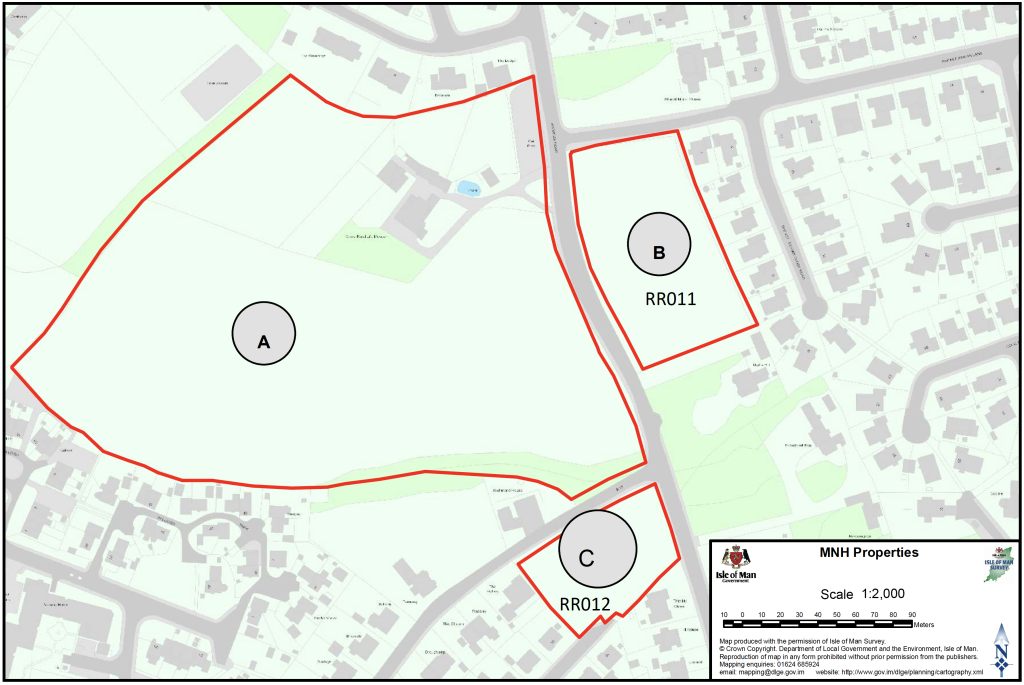
In 1976, the Manx Museum and National Trust purchased the Grove, its contents and adjoining land extending in total to approximately 14 acres from the Estate of Janet and Alice Gibb for £10,000 – see plan below. The Gibb sisters had previously granted an unrestricted option to purchase to the Trust, exercisable on the death of the last surviving sister and the Trust agreed to exercise the option at that time.
For the purposes of creating a museum, the Trust then carried out preparatory work, including the formal accession and documentation of the contents of the house and the provision of interpretation about the history of property, its owners and the objects.
In 1978, the Grove Museum opened to the public and its time capsule of period furniture and possessions provides a fascinating insight into the lives of three generations of a merchant family from Liverpool who made their home there.
The Grove Museum, Ramsey
Exploring Options
As part of the Public Inquiry for the draft Area Plan for the North and West, MNH has requested consideration be given to the zoning of two outlying fields for future residential development. One field is located to the south of the main Grove Museum site (labelled “C” RR012 on the plan) and is bounded by Richmond Road and Bowring Road and extends to approximately 0.97 acre.
The second field (labelled “B” RR011) is also separated from the Grove site, lying to the east of the main road (A9) leading from Ramsey to Andreas/Bride and extends to approximately 1.99 acres. Full details of each site and the planning rationale for zoning of the sites is included in the separate submissions made by Sarah Corlett, planning consultant, on MNH’s behalf. The timetable for the forthcoming Public Inquiry is in the public domain and the two sites are due to be considered on Friday 26 July 2024 in conjunction with other sites that have been put forward as alternatives or in addition to those currently allocated in the draft Plan.
https://nwinquiry.gov.im/media/t2ujj3ic/firm-programme-v2.pdf
Frequently Asked Questions
Was the Grove and the surrounding land gifted to the Trust?
No. Neither the Grove nor any of the adjacent land was bequeathed or gifted to the Trust.
How did MNH acquire the Grove and associated land?
The Trust purchased the Grove and adjacent land from the Estate of Janet and Alice Gibb, descendants of Duncan Gibb who had originally acquired property at the Grove in the 1830s.
Are there any covenants or restrictions preventing disposal or development?
The conveyance to the Trust does not contain any covenants or other restrictions that would prevent disposal or development of the land. MNH is however currently required to obtain Tynwald approval before permanent disposal of real property, should this situation arise.
Where can I see the original documentation and deeds of sale surrounding the purchase of the Grove and adjoining land from the Gibb estate?
The Title can be obtained online https://services.gov.im/deeds-probate-land-registry-document-search/deeds-and-probate/deed-index?documentId=Oct/1976/00088
Or by contacting the Land Registry Office:
Land Registry
Registries Building
Deemsters Walk
Bucks Road
Douglas
Isle of Man
IM1 3AR
Telephone:+44 1624 685249
Isn’t it the Trust’s role to protect the land held within its ownership?
MNH is responsible for protecting and promoting the Isle of Man’s natural and cultural heritage. MNH has a diverse portfolio of land and buildings which includes sites of high landscape and natural heritage value and many of the Island’s most historic buildings. Amongst these highly significant assets are a very small minority which have little or no natural or cultural heritage value or which may not be essential to MNH. In such instances, MNH would further explore the merits of a possible disposal option to generate income to the Charity while at the same time reducing its operation, conservation and maintenance overhead.
Why is MNH seeking to have these two sites allocated for future housing development?
MNH, as a charity, has a significant and costly conservation and maintenance deficit. In accordance with best practice asset management and in order to supplement MNH’s existing funding, it has been necessary to consider potential disposal options which would then be assessed in alignment with Area Plan development needs. These sites have been selected due to their potential for development, combined with the potential to create added value through the changed designation of the sites.
The two plots of land are not contiguous with The Grove Museum site as they are separated in each case by an adopted highway and any future housing development on this land will not detract from the Museum or adversely impact a visitor’s experience.
The sites are both located adjacent to existing services/infrastructure and within walking distance of the town centre.
If the new Area Plan for the North and West zones one or both of the fields for future residential development, does this automatically mean that housing will be built on them?
No. It is not necessarily the intention of the Trust to dispose of both sites and any future plans for developing the sites would still require any developer to submit detailed plans with a planning application and the application would then be determined on its merits as part of the normal planning process.
Is MNH planning to carry out the residential development?
No. MNH is undertaking the first stage to zone the land for potential development. In the event that this is achieved MNH will evaluate the options for the two sites, commission outline planning design before determining whether or not disposal of one or both plots to a developer should be recommended.
Has there been any engagement with stakeholders in advance of the submission?
Not at this early stage. In the event that the fields are zoned MNH will carry out local engagement on a design brief before a planning application for any proposed development.
Will development on either of these fields affect the presentation of the Grove Museum?
In the case of the two fields, their retention is not essential for the effective on-going presentation of the Grove Museum. From an ecological perspective a development brief will aim to ensure that features of interest and/or importance such as registered trees and hedges are appropriately protected. The plan below shows the registered tree area (RA 1995) in relation to the Richmond Road field.

If a sale of one or both sites takes place in the future, will all or some of the proceeds be reinvested in the Grove Museum?
The timescales for any possible future sale are uncertain and it will depend on the Trust’s priorities for investment at that time. In the foreseeable future, however, expenditure is going to be necessary at the Grove on structural repairs, including reroofing of outbuildings and further investment in the gardens and visitor facilities. Any future disposal of the land would help to support all aspects of MNH’s charitable work.
If MNH wishes to raise funds by selling the sites, why doesn’t the Charity just sell the sites without seeking to change the zoning of the land?
If the adopted Area Plan does zone the land for future residential development, then it will result in an increased land value compared to undesignated land and so it is important that MNH secures as much as possible of any increase in value rather than any third party acquiring the land.
How does any future sale of this land fit with any MNH strategy or policy?
In the context of a significant and growing operational, conservation and maintenance budget deficit, in addition to seeking additional grant from the Isle of Man Government/Treasury and making efforts to increase commercial and philanthropic income, it has been necessary for MNH to consider all options for income generation, and the identification of very small proportion of non-core property as potential sites for disposal was part of this process.
I own a house that backs on to MNH’s field- because of MNH’s ownership I thought my view/outlook would be protected from any future development?
The Trust’s ownership of land does not confer any protection for a neighbouring owner against a change of use of the land from an agricultural field. Loss of view or value for example, are not “material planning considerations”.
Why was a planning consultant engaged to represent MNH at the Public Inquiry? How much has that cost MNH / the taxpayer?
A professional planning consultant was engaged to evaluate the land in the context of the emerging North & West Area Plan and to prepare the application for consideration. The costs for this work are being paid by the Charity and no taxpayer money will be expended. These costs are commercially sensitive and have not yet been finalised, pending the consultant’s appearance on behalf of MNH at the Public Inquiry.
Why is the submission being made now?
The decision to submit these sites was taken following the initial stages of the Draft Area Plan as a result of a review of MNH landholdings highlighting the need to assess core and non-core land or property.
Why is MNH not identified as the landowner?
MNH was not required to be identified as the landowner during the application process.
For further questions or clarifications please contact: enquiries@mnh.im