
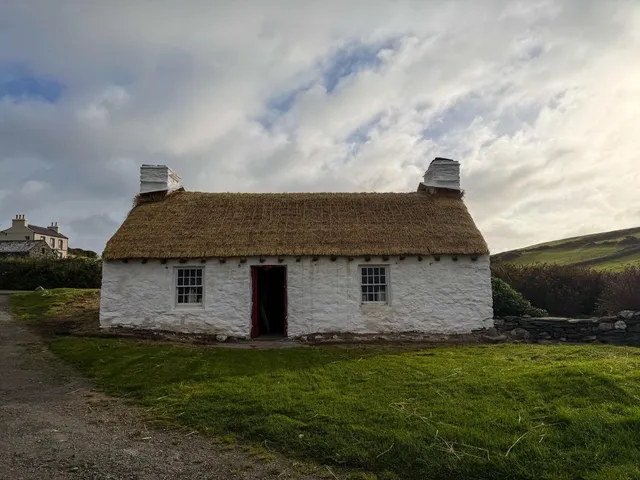
One of the Isle of Man’s most significant traditional buildings is set to reopen to visitors following the completion of major conservation works.
Harry Kelly’s Cottage at Cregneash has undergone an extensive programme of repairs after high winds and heavy rainfall damaged its thatched roof last year.
What began as a project to replace the damaged thatch developed into a wider programme of conservation, as Manx National Herritage’s specialists and contractors carefully investigated the historic structure beneath. Work has included repairs to the cottage’s stone walls, chimney stacks and eaves, whitewashing the walls, and replacement of the roof timbers and turf scraa. Finally, the roof was completely re-thatched in the Manx style which is unique to our Island.
The project has been informed by evidence uncovered during the works alongside research using historic photographs from the Manx National Heritage collections. This has allowed the conservation team to better understand how the cottage was constructed and maintained in the past and to retain as much original fabric as possible.
The cottage’s distinctive roof uses wheat straw thatch over a layer of thinly cut turf, known locally as scraa. During the project, traditional lime mortar, lime wash and locally sourced clay have also been used in repairs to the building.
John-Paul Walker, Historic Buildings Architect for Manx National Heritage, said:
“Harry Kelly’s Cottage looks like a very simple building, but conserving it properly requires an enormous amount of specialist knowledge and skill, from understanding the original construction to sourcing the right materials and using traditional techniques.
“We are proud to look after the places and collections in our care, so they remain part of Island life for generations to come. We are really pleased to have completed the work and to be able to welcome people back inside the cottage.”
Harry Kelly’s Cottage has particular significance to Manx cultural history. It was the home of Harry Kelly, a renowned native Manx speaker, and was gifted by his family to the Manx Museum following his death. It became the first building at Cregneash to open to the public in 1938, helping establish what became the first open-air folk museum in the British Isles.